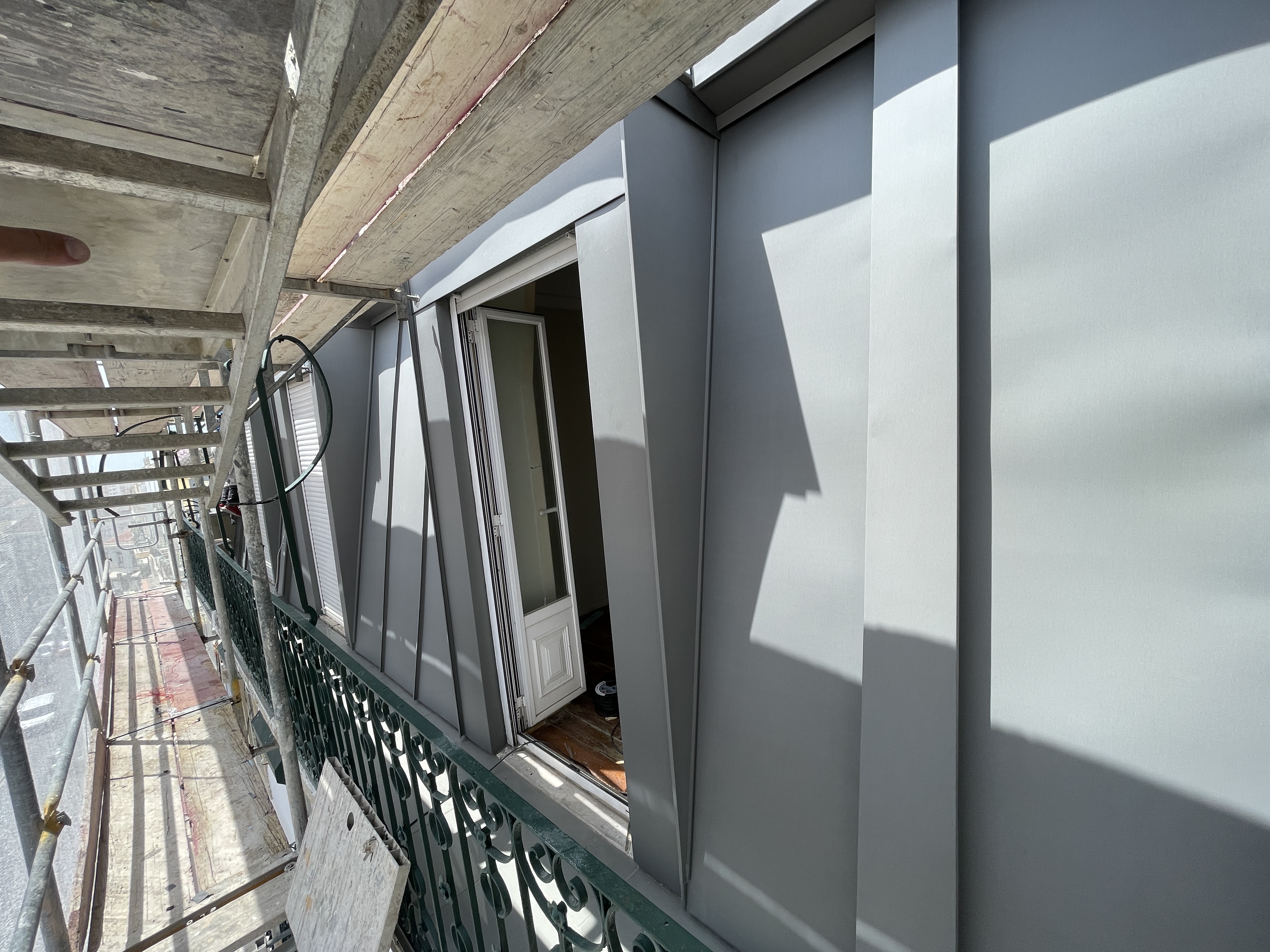
The roof is the most exposed element of any building, and the one whose performance shapes the thermal behaviour, watertightness and visual identity of the construction for decades. Zinc and copper roofs are the technical answer for projects where longevity, geometric precision and architectural expression cannot be compromised. We work on new builds, refurbishments and targeted repairs, from residential housing to industrial roofing, always with zinc or copper sheet installed by specialist sheet-metal crews.
Our team operates across mainland Portugal, with a particular presence in the North and Centre. Every roof is studied on site before fabrication so that the profile, gauge, seam system and ventilation match the actual substrate and the local exposure.
Standing-seam system
The standing seam, also known by its French name joint-debout, is the reference system for continuous metal roofing. It joins zinc or copper bays longitudinally by mechanically folding the upstands, forming a double-lock seam that seals the joint without piercing the sheet or relying on any chemical sealant.
From a construction standpoint, the system has three decisive advantages:
- Full watertightness. The seam sits above the water plane and depends on no rubber or silicone to resist rain or wind-driven water.
- Free thermal movement. The bays are fixed to the substrate with hidden fixed and sliding clips that absorb the metal's thermal expansion without stressing the sheet or producing audible noise.
- Suitable for low pitches. The double-lock standing seam works on shallow pitches (from around 5%, depending on manufacturer guidance), opening the system up to contemporary roof geometries with very low slopes.
The seam is closed on site with a powered seaming machine, ensuring an even lock along the full length of the joint. The visual result is a regular pattern of vertical lines that strengthens the elevation and stays clean as the metal weathers naturally.
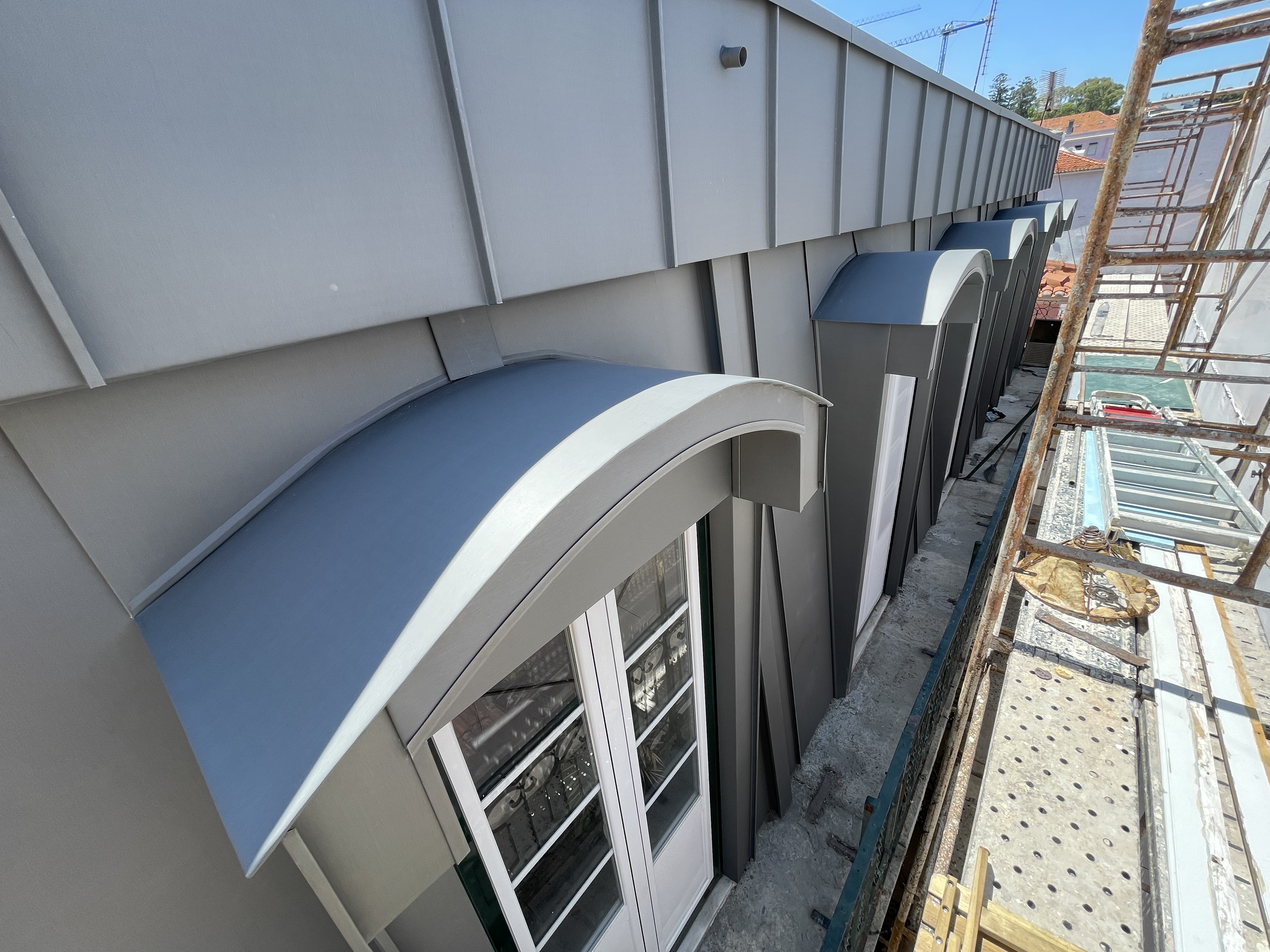
Curved (camarinha) roofs
In traditional Portuguese vocabulary, the camarinha is the curved or vaulted roof often associated with turrets, mansards, lanterns, curved porches and corner caps in classical architecture. Building a camarinha in zinc or copper is one of the most demanding tasks in roofing sheet-metalwork: every bay has to be cut and shaped to follow the curvature, and the seams have to develop along the radius while remaining perfectly parallel.
ZincArt fabricates and installs curved roofs on contemporary housing, on heritage refurbishments and on tower crowns. The geometry is set out from a dimensional survey of the structure, and the components are fully fabricated in our workshop so that only assembly and seam closure happen on site.
Materials we use
We work with zinc and copper sheet from the leading European mills in the sector, chosen for their metallurgical control and full lot traceability:
- VMZINC. QUARTZ-ZINC (light-grey pre-weathered) and ANTHRA-ZINC (dark-grey pre-weathered) finishes, plus natural zinc and the PIGMENTO range in several colours.
- elZinc. European zinc available in natural, pre-weathered and pigmented ranges.
- RHEINZINK. Zinc in prePATINA blue-grey and graphite-grey finishes, often specified by architects for tonal uniformity.
- Natural and pre-oxidised copper. For heritage and signature roofing.
All sheets are supplied with a certificate of origin and the manufacturer's technical data sheet, in line with EN 988 for rolled zinc in construction. More information at materials we use.
Components of the complete system
A metal roof does not end at the sheet plane. The durability of the assembly depends on the quality of the ancillary elements, fabricated in our workshop in the same material and finish as the roof itself:
- Gutters (half-round, rectangular or trapezoidal), sized to the catchment area.
- Downpipes in round or rectangular section, with brackets matched to the building height.
- Flashings at the transitions with walls, parapets and chimneys.
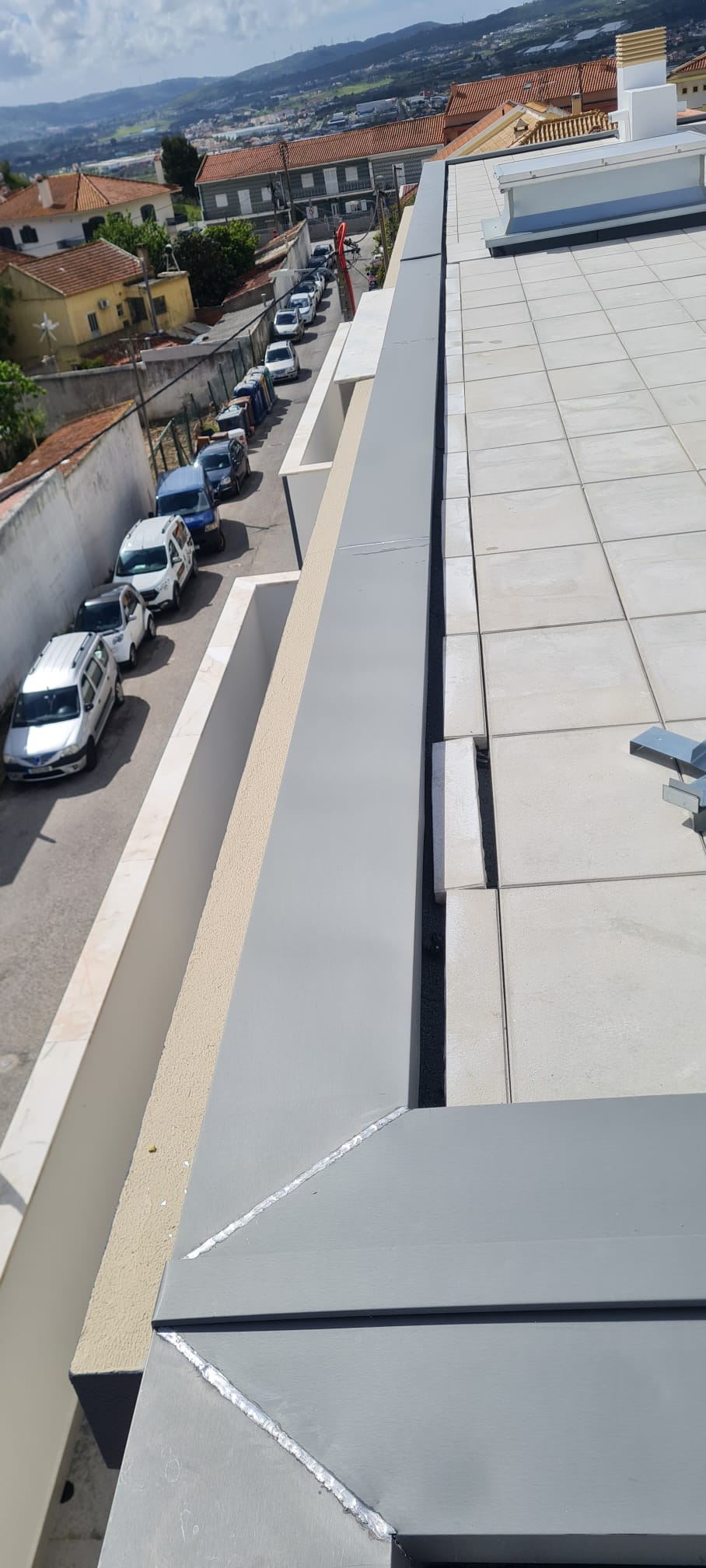
- Coping for low walls and parapets.
- Trims at ridges, eaves, verges and roof penetrations.
- Accessories such as chimney caps, vents, skylights and lanterns.
Full drainage is detailed on our zinc drainage systems page.
Durability and maintenance
The service life of a zinc roof depends mostly on the atmospheric environment. The reference values published by the European industry are around 90 to 100 years in rural settings, 40 to 60 years in urban settings and 30 to 40 years in aggressive industrial environments. In coastal locations, careful workmanship delivers between 40 and 70 years.
Routine maintenance amounts to periodic gutter cleaning, visual inspection of the trims and a check of the fixings. Zinc and copper need no painting and no chemical treatment: the natural patina that forms on the surface is itself the protective layer.
Where we work
ZincArt operates across mainland Portugal, with operational base in Porto. We carry out roofing in Lisbon, Porto, Braga, Coimbra, Aveiro, Leiria, Viseu and the surrounding districts. For projects outside these areas, contact us to confirm timelines and logistics.
Have a look at our project portfolio.